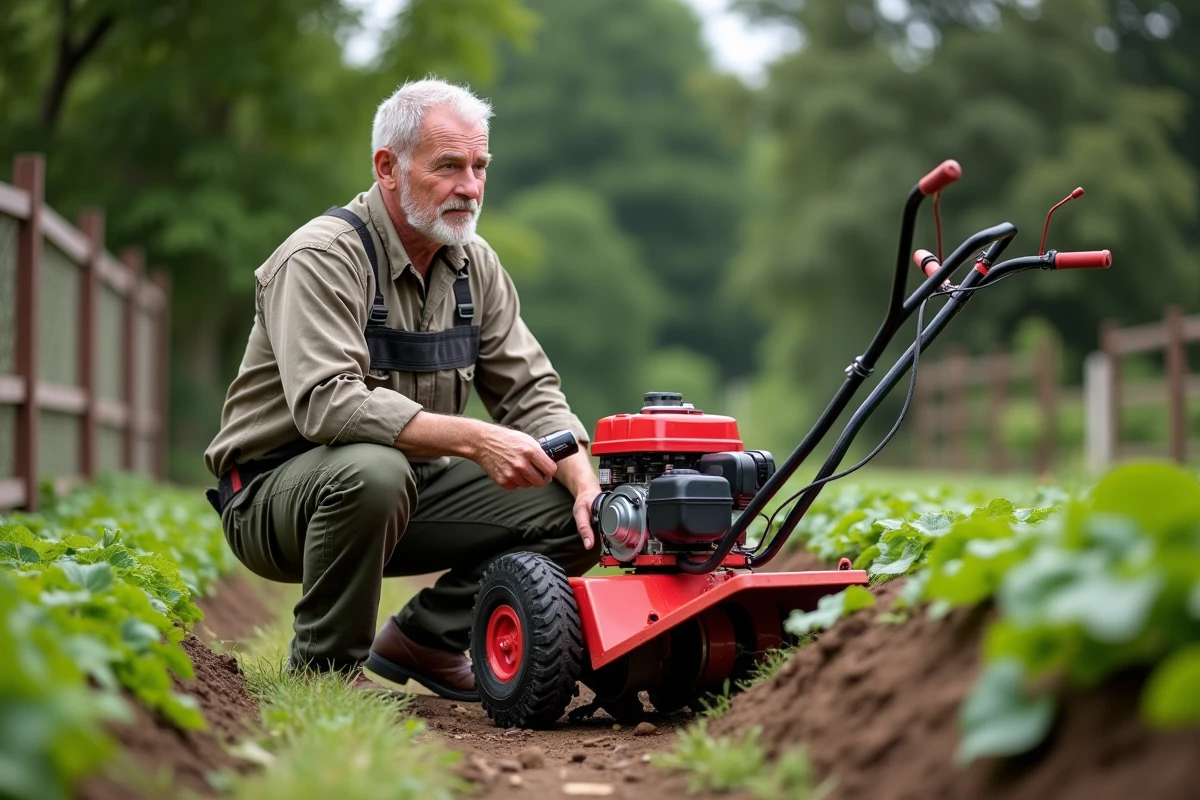
Even the latest models sometimes display unexpected resistance when starting, with no direct link to their age or frequency of use. Some failures escape usual checks, contradicting the common belief that regular maintenance would prevent all malfunctions.
Often overlooked components, such as the stop button or transmission safety, regularly cause difficult-to-diagnose blockages. However, a methodical diagnosis and a few targeted actions are often enough to resolve a large part of these incidents without resorting to professional intervention.
Why won’t a tiller start? Understanding the most common causes
When a tiller refuses to start, the blockage often manifests as a disconcerting mechanical silence. The origins of the problem lie in the most basic mechanics. A spark plug covered in deposits, fuel that has lost its qualities, a saturated air filter: these details, too often overlooked, explain the majority of failures. The engine, the centerpiece of the device, requires a clean fuel supply and a reliable spark. A clogged carburetor or deteriorated fuel is enough to bring everything to a halt.
Another point to watch: the engine oil level. Too much or too little, and a breakdown is guaranteed. A lack or excess of oil harms lubrication, causes overheating, and can block the machine. For combustion engines, the quality of the gasoline is equally important: only a recent and suitable mix (SP95 or SP98) allows for smooth operation. Electric models are not exempt from these issues: a dead battery or corroded cables can stop the starting process dead in its tracks.
The power transmission also holds its share of surprises: a slack belt, worn gears, or a temperamental choke. Signs such as abnormal noises, a loss of efficiency, or an increase in engine temperature should raise alarms and prompt immediate action. To delve deeper into the analysis and find suitable solutions for each situation, it is relevant to explore resources like why my tiller won’t start on Jardindivert, which provides a precise overview of symptoms and proven solutions.
The tiller assembles several major components: engine, carburetor, spark plug, filters, battery. A failure in any of them is enough to immobilize the machine. The warning signs are clear: loss of power, sudden stops, unusual noises. All these clues must be taken into account to quickly return to a normal situation.
Quick diagnosis: how to quickly spot the failure on your machine
Every tiller has its quirks, but it’s often by proceeding step by step that one finds the flaw. At the slightest refusal to start, it’s best to proceed methodically: observe, listen, smell. Absent noises, persistent gasoline odor, inert engine; these are all initial clues not to be ignored.
To carry out this diagnosis, it is essential to gather the right tools: spark plug wrench, screwdriver, wire brush, protective gloves. One usually starts with the spark plug. Simply removing it allows for checking its condition: black deposits, abnormal gap, trace of moisture. A careful cleaning with a wire brush may sometimes suffice; otherwise, a replacement is necessary. A flawless spark plug often reignites the ignition.
The air filter also deserves full attention. A clogged filter deprives the engine of the necessary oxygen. It should be removed, dusted off, or replaced if dirt has become embedded. The same goes for the fuel filter: even the slightest particle can obstruct fuel flow.
It is also necessary to check the electrical cables and the battery if the model requires it. An oxidized or poorly connected cable interrupts the circuit. On the mechanical side, the engine oil level must be checked rigorously; an excess or deficiency will affect operation, just as if the fuel is too old or unsuitable.
| Element to check | Symptom | Action |
|---|---|---|
| Spark plug | Soiling, moisture | Clean or replace |
| Air filter | Visible dirt | Clean or replace |
| Fuel | Odor, cloudy appearance | Drain and refill with fresh |
| Wiring | Oxidation, poor contact | Reconnect, clean |
By proceeding this way, the diagnosis sharpens, unnecessary trials are avoided, and the machine regains its vitality more quickly. Taking the time for these checks after each use drastically reduces the risk of breakdown at crucial moments.

Concrete solutions to get your tiller running without going to the workshop
A tiller that won’t start does not signal the end of work. Each component holds its share of surprises, and it is by targeting each sensitive point that it can be brought back to life. The first step never changes: address the most accessible issues, those that an attentive user can resolve at home.
At the slightest suspicion, the spark plug should be cleaned or replaced: a blackened or damp electrode renders the spark ineffective, jeopardizing any engine start. Changing the fuel remains a basic precaution: fuel that is too old loses its qualities, hinders combustion, and unnecessarily strains the mechanics. Prioritizing appropriate, fresh fuel stored properly makes all the difference.
The air filter must absolutely remain clean. A dirty or clogged filter suffocates the engine. It is often enough to remove it, shake it, or replace it if necessary. The same vigilance applies to the fuel filter: a clogged filter prevents fuel circulation, causing stalling or refusal to start.
For electric models, careful checking of the battery and cables is essential: even the slightest trace of oxidation, a faulty connection, or a drained battery can paralyze the ignition system.
Finally, regularly check the engine oil level. Too low, safety mechanisms engage; too high, lubrication becomes ineffective. Top up if necessary, and watch for the absence of foam or suspicious odors. Replacing worn parts (belt, choke, filters) preserves performance over time.
Some good habits facilitate the maintenance and reliability of your tiller:
- Systematic cleaning after use
- Storage in a dry and ventilated place
- Use of quality spare parts
A well-maintained tiller comes back to life without detours, ready to till the soil whenever you require it. The key lies in observation, rigor, and consistency: all allies to never be left stranded at the edge of the field.