
A professional website is not just a showcase. It is a working tool that captures leads, presents your services, and makes you findable at any time. Creating a website tailored to your business requires making precise technical choices from the start, or you risk having to redo everything a few months later.
Accessibility and legal compliance: what changes for professional websites
Before choosing a platform or provider, one point deserves your attention. Since June 28, 2025, the European Accessibility Act requires e-commerce sites to make their user journey accessible. SMEs with more than 10 employees exceeding 2 million euros in revenue or balance sheet are affected. Microenterprises are exempt for their services.
Specifically, a concerned site must publish dedicated accessibility information and provide a way to report a problem. Ignoring this obligation exposes you to sanctions, but above all, an accessible site improves the experience for all visitors, not just for people with disabilities.
Compliance does not stop there. The management of trackers depends on their purpose: a consent banner is required as soon as your site uses non-essential cookies. A properly configured audience measurement tool may sometimes be exempt from this consent, simplifying the user experience.
When creating your website, hiring a professional who understands these constraints, such as those listed on votre-site-internet.ch, prevents you from having to correct these shortcomings after the site goes live.

Choosing the right platform to create a website suited to your profession
Why is this choice so crucial? Because migrating from one platform to another costs time and money. WordPress, Wix, and other solutions meet different needs.
WordPress: flexibility and scalability
WordPress is suitable for businesses that plan to publish content regularly (articles, product sheets, case studies). The content management system allows adding features through extensions. The downside: WordPress requires regular maintenance (security updates, compatibility of extensions).
If you sell products online, the WooCommerce extension turns WordPress into a store. This option works well for medium-sized catalogs.
Wix: speed of deployment
Wix is aimed at freelancers or small businesses that want a functional site quickly. The visual editor requires no technical skills. The limitation appears when the site needs to evolve: customization options are more restricted than with WordPress.
The decision criterion is not the platform itself, but your needs in 18 months. A craftsman wanting to showcase their work and receive quote requests does not have the same requirements as a business managing a stock of several hundred references.
Design and page structure: what truly retains a visitor
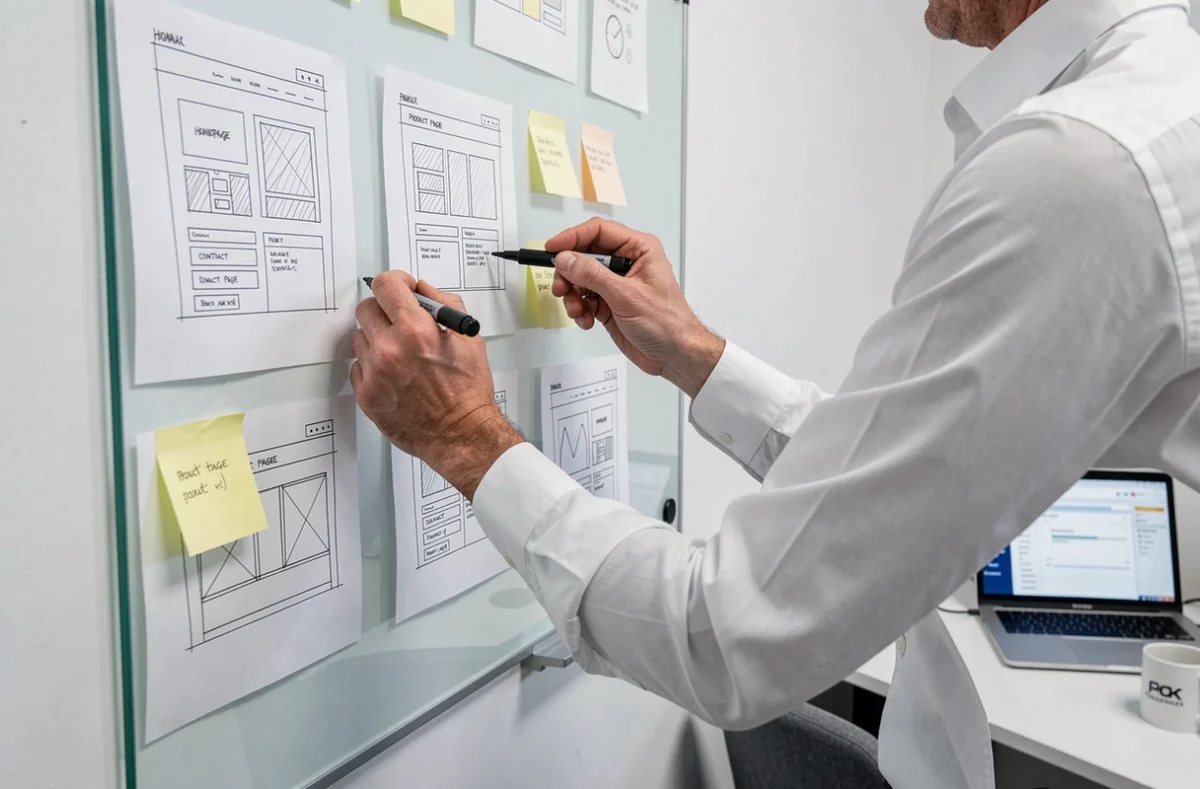
The design of a professional site is not judged by its beauty. It is judged by its ability to guide the visitor towards an action: requesting a quote, calling, purchasing, signing up. Two principles are enough to structure an effective site.
- Each page must have a unique objective. The homepage guides, the service page explains, the contact page converts. Mixing these functions dilutes the message and drives visitors away.
- Navigation must be readable in less than three seconds. A menu with a maximum of five to seven entries, a visible call-to-action button without scrolling the page, a clickable phone number on mobile.
- Loading time matters more than animations. A site that takes more than a few seconds to display loses a significant portion of its visitors even before they have read the first line.
Responsive design (suitable for smartphone screens) is no longer optional. The majority of consultations are done on mobile. A site with buttons that are too small or text that overflows the screen sends a signal of unprofessionalism.
Natural referencing and visibility on search engines
Having a website online guarantees nothing. Without SEO work, your site remains invisible. SEO (natural referencing) involves making your pages understandable for search engines so that they appear when a potential customer types a query related to your business.
The technical basics of SEO to integrate from creation
Each page must target a main keyword present in the title, URL, and first paragraph. Meta tags (title and description) serve as a showcase in search results: a clear title and a description that entices clicks increase the visit rate.
The structure of the content also matters. Hierarchical headings (H2, H3), short paragraphs, images with descriptive alt text: these elements help search engines understand the subject of each page.
The impact of AI responses on site traffic
SEO must now take into account the potential decrease in clicks caused by AI-generated responses in search results. No special markup is officially required to appear in these AI responses. A page must primarily be indexed and eligible for standard results. Files like llms.txt do not condition inclusion in AI Overviews.
This observation changes the strategy: publishing detailed and well-structured content remains the best approach, but it is also necessary to diversify your sources of online visibility (social networks, Google Business listing, e-reputation).
Content and customer data: two often neglected pillars
A site without regular content stagnates in the results. Publishing articles, practical guides, or case studies related to your services creates additional entry points to your site.
- An article that answers a common question from your clients attracts qualified traffic, ready to take action.
- Carefully written product or service sheets (not copied from a supplier) rank better in results.
- The data collected through your site belongs to you, unlike that generated on social networks or marketplaces. Contact forms, newsletter sign-ups, quote requests: this information directly fuels your business development.
Creating a professional website is laying a foundation that you fully control. The choice of platform, legal compliance, conversion-oriented design, and SEO form a coherent whole. Every decision made at creation conditions the results of the following months, making the time spent properly framing the project as valuable as the site itself.